



%20(1).png)
How to Break Old Patterns and Build High-Performance Habits That Stick
High-performance habits aren’t built through willpower alone.
They’re built through design.
Many leaders start the year with strong intentions: better focus, better energy, better boundaries and yet find those habits slipping as pressure increases. This isn’t a discipline problem. It’s a behaviour design problem.
In a recent RISE Live Session, peak performance strategist Abi Ireland explored how to break old patterns and embed habits that hold up under real-world pressure. This article distils the key insights combining Abi’s practical guidance with proven behavioural psychology into an easy, actionable read for RISE members who want results without the overload.
Why high performers still struggle with habits
Psychologists estimate that up to 47% of our daily behaviours run on autopilot, while as much as 90–95% of our thinking is unconscious. In other words, when pressure rises, we default to what’s already wired.
That’s why habits built on motivation alone tend to collapse.
If a habit can’t survive stress, it wasn’t designed for performance.
Sustainable high-performance habits work with human psychology, not against it.
The COM-B model: a practical framework for behaviour change
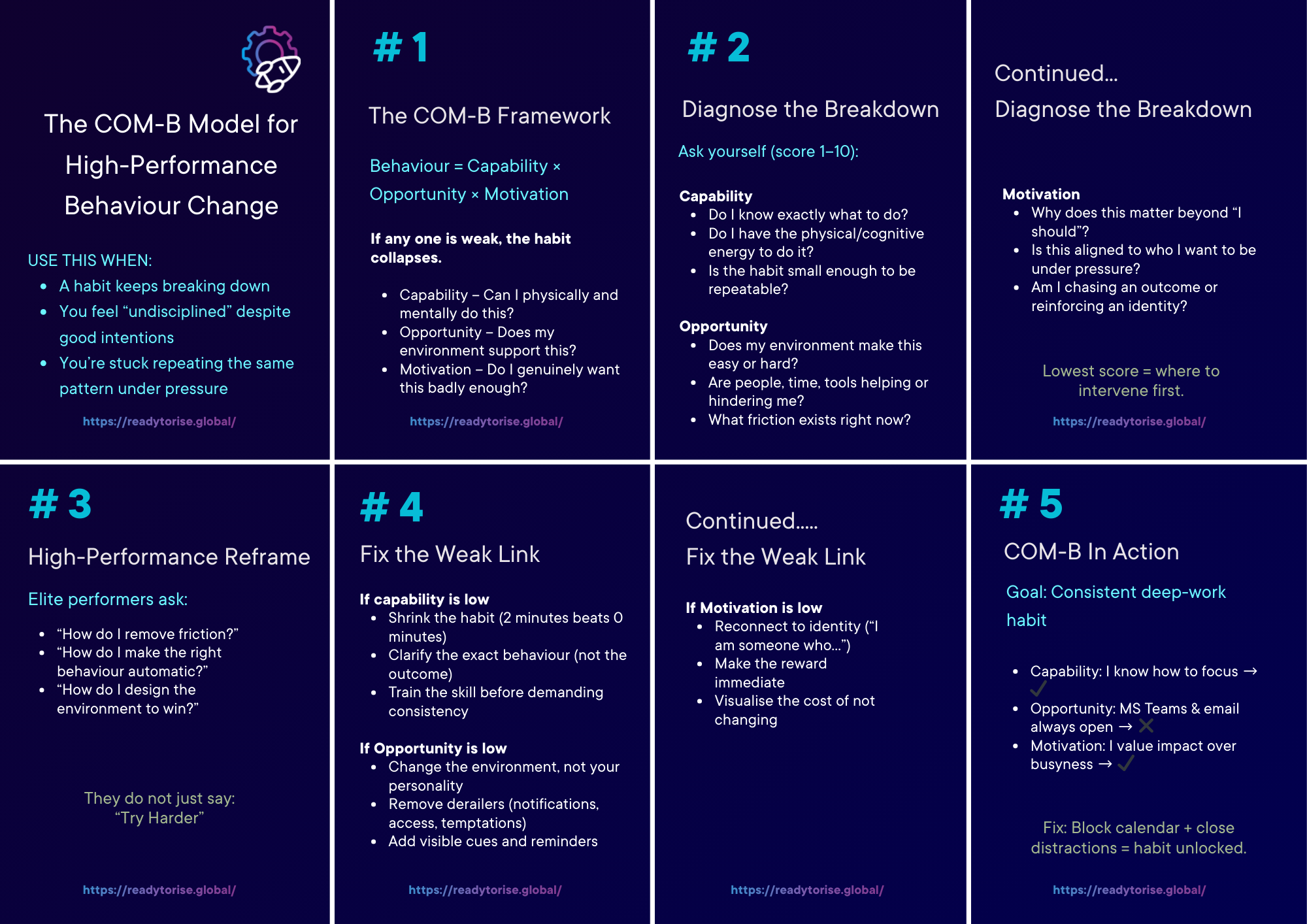
One of the most effective tools discussed in the session is the COM-B model, developed by behavioural scientist Susan Michie.
The model explains that behaviour only happens when three conditions are present:
- Capability – you have the physical and psychological ability
- Opportunity – your environment supports the behaviour
- Motivation – the behaviour genuinely matters to you
If one element is missing, the habit breaks, no matter how committed you feel.
Stop blaming discipline & fix the system
High performers don’t ask:
“Why can’t I just be more disciplined?”
They ask:
- What friction exists in my environment?
- What decisions can I remove?
- What systems make the right behaviour easier than the wrong one?
This shift from effort to design is where habits become unbreakable.
Identity beats motivation every time
Research popularised by James Clear shows that habits stick best when tied to identity, not outcomes.
Instead of:
- “I need to focus more”
- “I should sleep better”
High performers reframe to:
- “I’m someone who protects my energy”
- “I operate with clarity under pressure”
When a habit reinforces who you believe you are, consistency becomes far easier, especially when motivation dips.
References & Further Reading
- Susan Michie et al. (2011) — The COM-B Model of Behaviour Change
- Atomic Habits — James Clear
- Tiny Habits — BJ Fogg
- The Power of Habit — Charles Duhigg